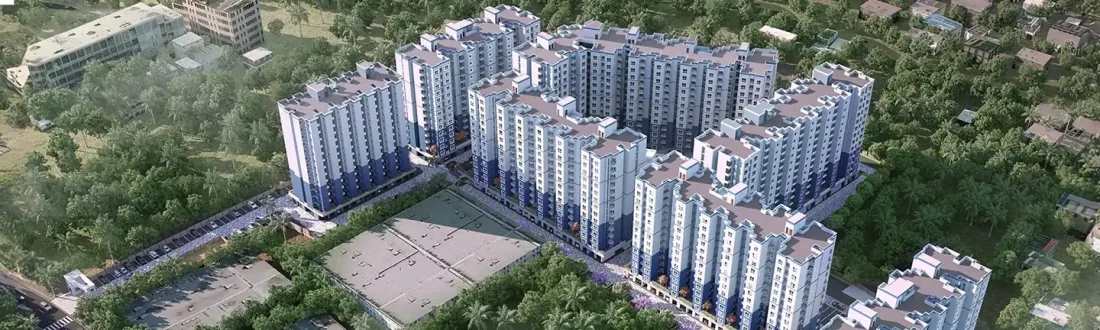
Tamil Nadu's Chief Minister approved a Rs 1,401.75 crore project to build 6,157 affordable tenements across nine locations in Chennai on November 13, 2026. It's a sizeable number, and one that sits alongside a string of other housing-policy moves the state government has made through the year, from a new online sales portal for existing Tamil Nadu Housing Board stock to a fresh amendment to the state's RERA rules issued just a week earlier, on November 6. For most buyers reading this site, who are typically evaluating private apartments in the mid-market to premium range, the direct impact on any specific project's price is minimal. But the announcement is still worth understanding, because it says something about where the state sees Chennai's housing gap, and about how actively Tamil Nadu is trying to close it from the public-supply side.
1. What the Rs 1,401.75 Crore Approval Actually Covers
The scheme funds 6,157 tenements spread across nine separate locations in Chennai, a scale that puts it among the larger state-backed affordable housing pushes the city has seen in recent years. Tenements of this kind are typically built and allotted through state housing bodies rather than sold on the open market in the way a private developer's apartment is, and they are generally priced and allocated specifically for economically weaker and lower-income households, a different buyer segment entirely from the one most private Chennai developments, including the projects Luxura Habitat markets, are built for. The nine-location spread also suggests the state is trying to address housing need across multiple parts of the city rather than concentrating the new supply in one or two large sites, which tends to be the more administratively complex, but more equitable, way to run a scheme at this scale.
2. A Pattern of Housing-Policy Activity, Not an Isolated Announcement
This approval doesn't stand alone. Just a week earlier, on November 6, 2026, Tamil Nadu's Housing and Urban Development Department issued an amendment to the Tamil Nadu Real Estate (Regulation and Development) Rules, 2017, continuing a year in which the state has already rolled out a Tamil Nadu Housing Board online sales portal in August, offering thousands of units on a first-come, first-served basis, and a state budget that included a "My Home" scheme aimed at middle-income families. Taken together, these moves describe a state government treating housing supply, across the income spectrum, as an active policy priority rather than a background issue, which is generally a reasonable signal for the overall health and direction of Chennai's housing market, even when any single scheme doesn't touch the private segment directly.
- 6,157 tenements, Rs 1,401.75 crore, nine locations, approved November 13, 2026, aimed at economically weaker and lower-income households.
- A TN RERA rules amendment issued November 6, 2026, a separate but same-week regulatory move.
- A broader 2026 pattern: a Housing Board online sales portal, a middle-income "My Home" scheme, and now this affordable tenement approval, together suggesting sustained state attention to housing supply across price points.
3. Why This Still Matters to Private-Market Buyers
Government and private housing supply rarely compete for the same buyer, so this scheme is unlikely to move prices or demand in the mid-market or premium apartment segments where most of Chennai's active private launches sit. What it does offer is useful context: a state government actively building at scale for its lowest-income residents is, indirectly, a state government less likely to neglect the infrastructure, approvals pipeline and regulatory clarity that also benefits private development. For buyers specifically looking at the more affordable end of the private market, projects like Shriram Swargam in Kuthambakkam, offering 1, 2 and 3 BHK homes from around Rs 38 lakh across 1,053 units on 8.9 acres, sit closer in spirit, if not in allocation mechanism, to the price-conscious end of the market this new scheme is also targeting.
4. What to Watch Next
Buyers and investors tracking Chennai's broader housing policy direction should keep an eye on how the November 6 TN RERA rules amendment plays out in practice, since rule changes of this kind can affect project registration timelines, disclosure requirements or completion extensions across both public and private developments. It's also worth watching whether the nine locations named for this tenement scheme overlap with any growth corridors where private developers are also active, since public infrastructure investment accompanying a government housing project, roads, utilities, local amenities, can indirectly support nearby private developments even when the housing stock itself serves a different buyer.
The Bottom Line
Tamil Nadu's Rs 1,401.75 crore approval for 6,157 Chennai tenements is primarily a public-housing story, not one that will move pricing in the private apartment segment most buyers on this site are evaluating. But it is a useful data point about the state's broader housing policy momentum through 2026, alongside the TN RERA rules amendment and the Housing Board's other initiatives this year, and it is worth keeping on your radar as part of the wider picture of how Chennai's housing market is evolving. Talk to our team for a closer look at Chennai's private apartment market across price bands.