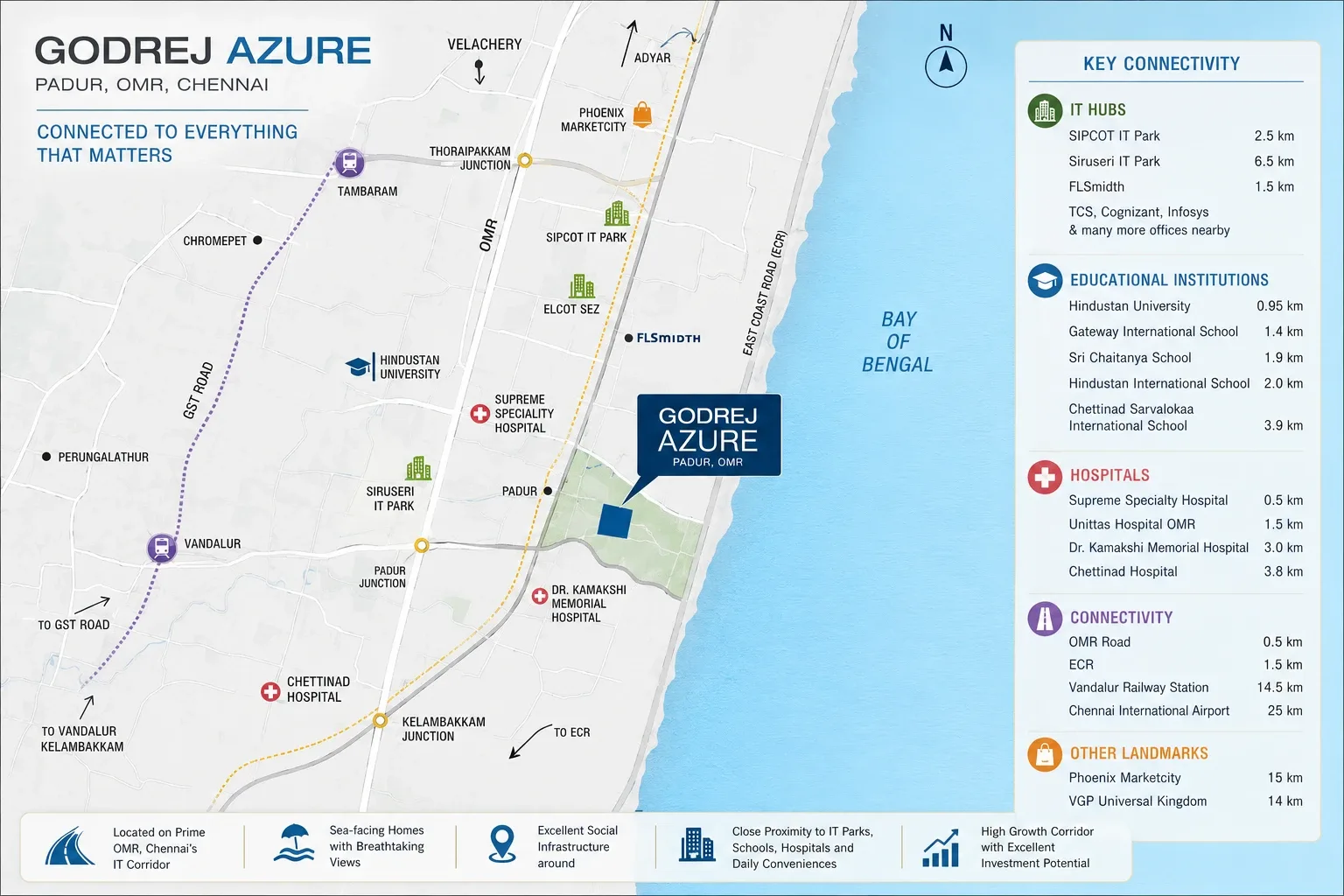
Chennai's apartment market posted its strongest first half in recent memory, according to JLL data reported in early September 2026. Apartment sales rose 27% year-on-year to 8,587 units between January and June 2026, while average prices climbed 13% over the same period. That growth rate placed Chennai second among India's seven major real estate markets tracked in the report, a notable jump for a city that has historically grown at a steadier, less headline-grabbing pace than Bengaluru or the NCR.
1. What the Numbers Actually Show
An 8,587-unit sales figure for a six-month window, combined with a double-digit price increase, points to demand that's outpacing what a "stable but slow" market usually produces. JLL's report attributes a substantial part of this to improving connectivity from the Outer Ring Road (ORR) and Peripheral Ring Road (PRR), infrastructure projects that are gradually opening up residential corridors that weren't previously on most buyers' shortlists. When a ring road segment becomes usable, it effectively shrinks the commute time between a new residential pocket and the city's established employment hubs, which is usually the single biggest factor that gets a new locality onto a serious buyer's list.
2. Why Connectivity Is Doing the Heavy Lifting
Chennai's residential growth has traditionally clustered along OMR (Old Mahabalipuram Road) because that's where the city's IT and ITES employment is concentrated. Ring road connectivity changes that equation by making it feasible to live further from OMR itself while still reaching it, or other employment clusters, within a reasonable commute. That's a structurally different growth driver than a single hot corridor getting more expensive: it widens the map of what counts as a "connected" Chennai address, which is consistent with sales growth outpacing price growth on a percentage basis in this report.
- 27% sales growth against 13% price growth suggests more units are transacting at a healthy pace, not simply that fewer, pricier units are moving.
- Second-highest growth among 7 major markets is a meaningful comparative signal, not just an absolute number, since it places Chennai's momentum above most other large Indian cities in this specific period.
- Ring-road-linked corridors deserve a fresh look if you dismissed them a couple of years ago as too far from work; the underlying commute math may have changed.
3. What This Means If You're House-Hunting in Chennai
A sales surge like this is usually a leading indicator that a wider set of localities are about to get more expensive, not a reason to panic-buy the first listing you see. If you've been sitting on the fence about a Chennai purchase, the practical takeaway is to widen your search radius along the specific ORR and PRR-linked corridors this report highlights, since that's precisely where a first-mover advantage on price is more likely to still exist before wider awareness catches up. Established employment-linked corridors like OMR remain a safer, if pricier, bet.
4. Chennai Options Worth Evaluating Right Now
If you want exposure to Chennai's current growth story without speculating on an unproven micro-market, established residential clusters within striking distance of the city's employment corridors remain a reasonable starting point. Shriram Kinglife in Koyambedu sits centrally with strong existing connectivity, while corridors further along OMR continue to benefit from the IT-led demand this report describes.
The Bottom Line
Chennai's H1 2026 sales numbers are a genuine, dated data point, not marketing spin: a 27% jump in units sold alongside a 13% price increase is a strong signal of real demand, largely credited to improving ring-road connectivity. Whether that demand has already been priced into a specific project or locality is exactly the kind of question worth asking before you commit. Talk to our team about which Chennai corridor actually fits your budget and commute.