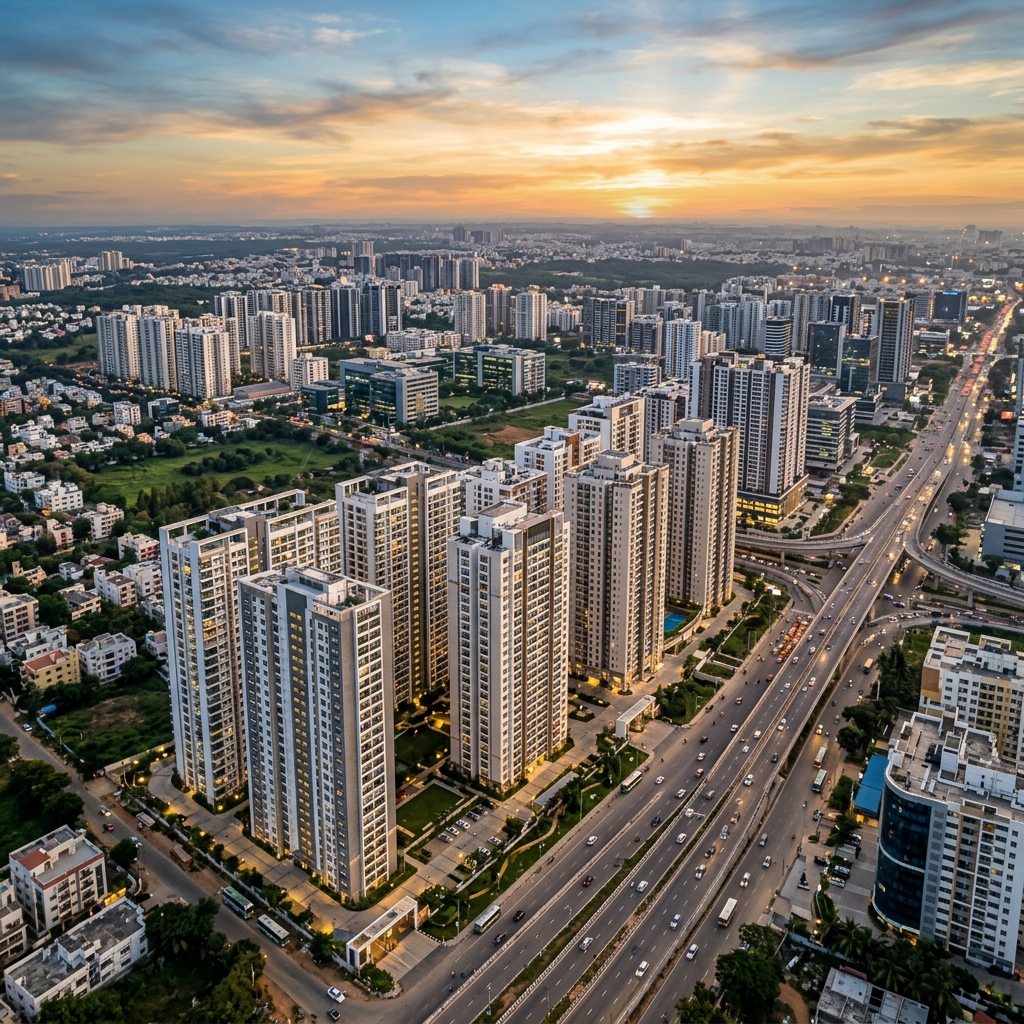
If you are tracking the Hennur–Thanisandra real estate market, you are looking at one of Bangalore's most consistently high-performing micro-markets of the last five years. Anchored by Manyata Tech Park, the city's largest single-campus tech park, home to over 80,000 working professionals, and bookended by Hebbal in the west and the airport corridor in the north, this belt has built a structural demand floor that insulates it from the broader market cycles that periodically hit other corridors. This guide walks through exactly why that is, what the price data actually shows, and who is buying here in 2026: so you can judge for yourself whether the belt fits your own plans.
1. What Drives Hennur–Thanisandra's Property Demand
Unlike purely residential corridors that rely on speculative buying, the Hennur–Thanisandra belt has earned its demand from real end-user and rental activity. Three anchors explain the consistent performance:
- Manyata Tech Park: Employs 80,000+ professionals across Accenture, IBM, Cognizant, Dell, and dozens of other Fortune 500 tenants. These are salaried professionals with disposable incomes and a strong preference for 2 and 3 BHK homes within 15–20 minutes of their workplace.
- Outer Ring Road (ORR): The 65km orbital highway that lets Bangalore commuters skip the congested city core entirely. It provides seamless east-west connectivity, linking Hennur to Marathahalli, Whitefield, and the entire eastern tech corridor without the need to enter the CBD.
- Airport Connectivity: The NH-44 (Bellary Road) via Hebbal provides a direct, uncongested route to KIAL (Kempegowda International Airport): a significant advantage for executives and frequent fliers.
How the Commute Math Actually Works
The "15–20 minute commute to Manyata" figure you'll hear from every broker in this belt isn't marketing spin: it's a direct consequence of geography. Manyata Tech Park sits right off the ORR, and Thanisandra Main Road feeds almost directly onto that same ring road a few kilometres from the campus gates. That means a resident here doesn't have to fight through a string of signal-heavy arterial roads to get to work; they join a limited-junction highway and stay on it almost the whole way.
Compare that to commuting into Manyata, or into a comparable ORR-linked campus like Kirloskar Business Park in Hebbal, from a corridor that isn't sitting directly on the ring road. Commuters from those areas typically cross several congested junctions just to reach the ORR in the first place, before the "highway" portion of their commute even begins. In Hennur–Thanisandra, that friction is largely absent. It's proximity to the ring road itself, not proximity to any single office tower, that compresses commute times this consistently.
2. Price Trends: Hennur–Thanisandra 2021–2026
| Year | 2 BHK (₹/sqft) | 3 BHK (₹/sqft) | Rental Yield | YoY Change |
|---|---|---|---|---|
| 2021 | ₹5,200–6,000 | ₹5,500–6,500 | 3.8–4.5% | : |
| 2022 | ₹6,000–7,000 | ₹6,500–7,500 | 4.0–4.8% | +15% |
| 2023 | ₹7,000–8,200 | ₹7,500–9,000 | 4.2–5.0% | +18% |
| 2024 | ₹8,200–9,500 | ₹9,000–10,500 | 4.0–4.8% | +17% |
| 2025 | ₹9,500–11,000 | ₹10,500–12,500 | 3.8–4.5% | +16% |
| 2026 (current) | ₹11,000–13,000 | ₹12,000–14,500 | 3.5–4.2% | +14–18% |
Two quick definitions for first-time buyers before you read that table further. Psf simply means "per square foot": it's the price of a home divided by its area, and it's the standard unit Bangalore's market uses to compare properties of different sizes on a like-for-like basis. Rental yield is the annual rent a property earns divided by its purchase price, expressed as a percentage: it tells you how a home performs as an income asset, separate from what happens to its resale value.
Read the table as a five-year story rather than a single number: 2 BHK pricing has roughly doubled since 2021, while rental yields have actually compressed slightly, from the high-3s/low-4s to a narrower 3.5–4.2% band in 2026. That's a normal pattern in a corridor where capital values are rising faster than rents: it doesn't mean rental demand is weakening, just that price growth has, for now, outpaced rent growth.
3. The Manyata Effect: Why This Micro-Market Doesn't Correct
Most real estate micro-markets correct when speculative demand dries up. Hennur–Thanisandra has barely corrected through three distinct market downturns (the 2019 slowdown, COVID, and the 2023 interest rate spike) because its demand is structurally employment-anchored. When Manyata Tech Park adds a new tenant, as it does regularly, rental demand within a 5km radius strengthens almost immediately.
Why Employment-Anchored Demand Behaves Differently
In a purely speculative micro-market, demand can evaporate quickly once investor sentiment shifts: there's no rental backstop underneath the resale price, so when buyers step back, sellers have to cut prices to find a taker. Hennur–Thanisandra doesn't have that problem in the same way. Even in a quarter where resale demand cools, tens of thousands of salaried Manyata tenants still need somewhere to live near their office. That keeps rents relatively stable, and stable rents give landlords a reason to hold rather than sell into a soft market: which is exactly the mechanism that has kept this belt from correcting the way more speculative corridors periodically do.
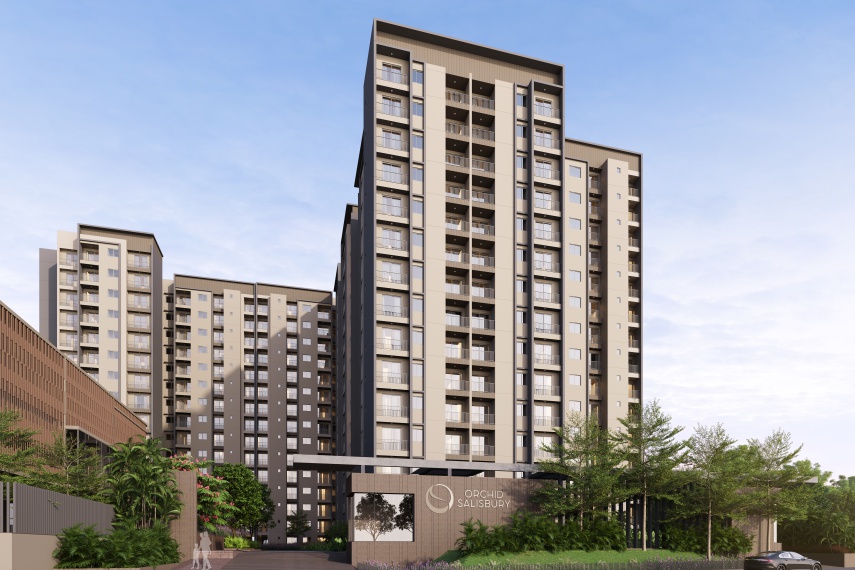
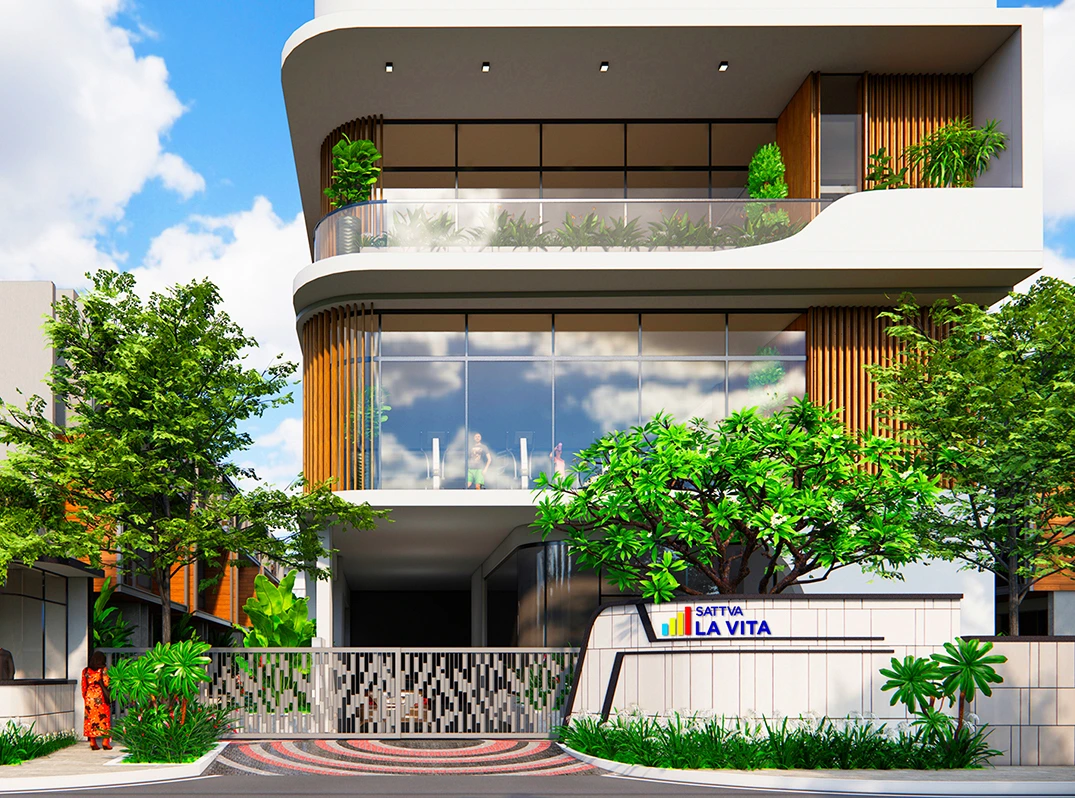
Projects like Goyal Orchid Salisbury and Sattva La Vita are positioned to capture this sustained demand, offering both end-user and investor-grade product in the same belt.
4. Who is Buying in Hennur–Thanisandra in 2026?
- Senior IT Professionals (45%): buying as primary residences. Most are upgrading from a 2 BHK in HSR or Koramangala to a larger 3 BHK here, trading a shorter commute to the old CBD-adjacent office parks for more space and a newer building.
- Rental Investors (30%): targeting Manyata Tech Park's corporate tenant demand. Typically purchasing 2 BHKs in the ₹1.0–1.5 Cr range with a 4–5% yield target, and treating the purchase as a long-term income-plus-appreciation play rather than a quick flip.
- Families relocating from abroad (25%): attracted by proximity to high-quality international schools (Canadian International School, Ryan International) and straightforward airport access for frequent travel back to their base country.
What This Means If You're Buying to Rent
It helps to see the rental-investor math worked through rather than just quoted as a percentage. Say you buy a 2 BHK here for ₹1.1 Cr, roughly the midpoint of the range rental investors are targeting, and it rents out for about ₹28,000 a month, which is a realistic mid-range figure for this corridor. Annual rent works out to ₹3,36,000. Divide that by the ₹1.1 Cr purchase price and you get a gross yield of just over 3%: consistent with the 3.5–4.2% band in the table above once you account for the fact that a portion of any year can go by without a tenant, or with a lower opening rent before the first renewal. That gross number still isn't your take-home: maintenance charges, property tax, and any brokerage or vacancy period between tenants all come out of it before you see net cash flow. It's a helpful exercise before you buy, not after.
Outlook for 2026–2028
The supply pipeline in Hennur–Thanisandra has tightened noticeably. New project launches are increasingly on smaller land parcels, which keeps supply constrained relative to demand rather than flooding the corridor with new inventory all at once. Combined with Manyata's continuing tenant additions and the proposed Namma Metro extension via Nagavara, the underlying demand drivers behind the current appreciation trend look intact through 2028: though as with any single-corridor real estate bet, it's worth pairing this with your own risk tolerance and time horizon rather than treating past performance as a guarantee.