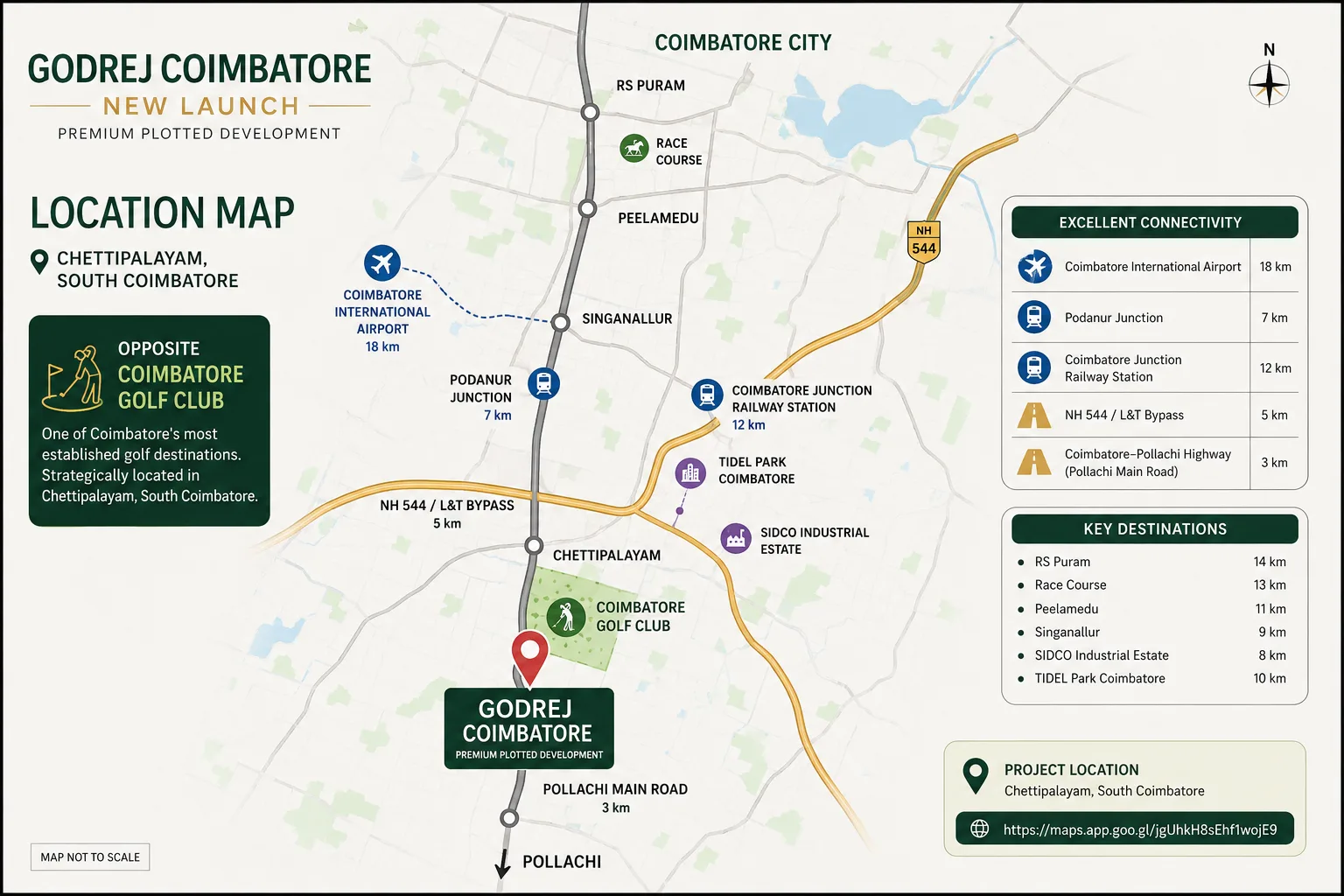
Coimbatore's real estate market gives buyers a genuine choice most other Tier-2 Indian cities don't offer at scale: a healthy supply of both plotted developments and apartment projects across comparable price points. That choice is also a genuine dilemma. Plots and apartments build wealth through fundamentally different mechanics, carry different risks, and suit different buyer profiles. Here's an independent, unbiased breakdown of how to think about the decision.
1. The Core Trade-off: Appreciation vs Convenience
The simplest way to frame the choice: plots are a bet on land appreciation with construction deferred to your own timeline; apartments are a bet on a finished, income-generating asset available immediately. Land, unlike a building, does not depreciate with age or degrade with maintenance neglect. Its value is a function of location, demand and development activity around it, largely independent of what happens on the plot itself. An apartment's value, by contrast, is tied partly to the building's age, upkeep, and how well the maintenance association manages shared costs over time, factors entirely outside a buyer's individual control.
2. How Plots Build Wealth Differently
Because land doesn't depreciate, a well-located plot in a growing corridor can compound in value over 5-10 years without the buyer doing anything beyond holding it. Plotted developments also typically carry lower ongoing costs than apartments: no monthly maintenance charge (beyond a modest layout-maintenance fee for shared amenities), no building depreciation to offset, and no dependency on a maintenance association's competence. The buyer also retains full control over when and how to build, which lets construction costs be spread out, timed against personal cash flow, or deferred entirely if the plan is pure appreciation rather than self-use.
The trade-off is that a plot generates zero income until construction is complete, and the buyer bears full responsibility, and full risk, for managing a construction project: contractor selection, cost overruns, timeline slippage and quality control are all on the buyer, not a developer with an established delivery process.
3. Where Apartments Win
Apartments have two clear advantages a plot cannot match. First, rental income: a completed apartment near an employment hub can be rented out from day one of possession, generating cash flow that a vacant plot simply cannot. This matters most in corridors with strong working-professional demand, for instance near TIDEL Park Coimbatore or the SIDCO Industrial Estate, where ready-to-move housing commands consistent rental interest. Second, convenience and certainty: an apartment comes with a fixed specification, a stated possession date, and (for a RERA-registered project) a legally enforceable delivery commitment. There's no construction project to manage, no contractor risk, and no multi-year gap between purchase and a livable, income-generating asset.
4. Coimbatore-Specific Factors That Tilt the Decision
A few factors specific to Coimbatore's market are worth weighing directly:
- High per-capita income: Coimbatore is often recognised as one of Tamil Nadu's highest per-capita-income cities, supported by its industrial and entrepreneurial base, which sustains demand for both premium plots and premium apartments simultaneously rather than favouring one format over the other.
- Textile and mill-family diversification: many traditional textile and mill-owning families in Coimbatore have been actively diversifying into real estate, historically favouring land and plotted developments as a familiar, tangible asset class.
- Logistics and IT employment growth: Coimbatore's emergence as a major logistics hub after Chennai (Amazon and Flipkart facilities alone employ nearly 30,000 people) and its established IT presence via TIDEL Park both favour apartments for rental demand, since these are largely working-professional tenant pools that need ready housing now, not land to build on later.
- Airport expansion and infrastructure pipeline: a planned Terminal 2 expansion across roughly 630 acres along Avinashi Road is a multi-year catalyst that tends to lift land values broadly across the corridors it touches, a dynamic that favours plot holders with the patience to wait it out.
5. Risk Considerations: RERA, Construction and Financing
Both formats carry real risk, but of different kinds. On a plot, the primary risks are legal (unclear title, missing DTCP layout approval, unresolved encumbrances on the specific plot) and execution risk sits entirely with the buyer once construction begins. On an apartment, the primary risk is developer-side: construction delays, quality shortfalls, or, in the worst case, a stalled project, though RERA registration meaningfully reduces this by ring-fencing buyer funds and enforcing delivery timelines. Financing also differs meaningfully: apartment home loans are generally straightforward since the project and developer are pre-approved by the lender, while a pure plot loan typically comes with a lower loan-to-value ratio and shorter tenure, and a composite plot-plus-construction loan requires additional approval stages once construction starts.
6. A Practical Decision Framework
| Factor | Favours Plot | Favours Apartment |
|---|---|---|
| Investment horizon | 5-10+ years | Immediate to medium-term |
| Income needs | No income needed until self-built | Rental income wanted now |
| Risk appetite | Comfortable managing construction risk | Prefers developer-managed delivery |
| End goal | Custom self-build or pure land appreciation | Ready-to-move or rental asset |
| Financing preference | Can fund construction separately/in stages | Wants a single straightforward home loan |
If you're specifically evaluating a plotted option in this market, our review of the newest branded plotted launch in South Coimbatore may help: Godrej Plots Coimbatore: Price, RERA & Plot Sizes Review. And if the Golf Club micro-market's fundamentals matter to your decision, see: Plots Near Coimbatore Golf Club: Chettipalayam Location Guide. If you'd rather compare a Ready-to-Construct, already-RERA-registered plotted layout instead of a pre-launch one, see our guide to Coimbatore's other active plot corridor: Plots in Kovaipudur, Coimbatore: Location & Investment Guide.
Our Honest Assessment
Neither plots nor apartments are the objectively "better" investment in Coimbatore; the honest answer depends entirely on what you're optimising for. If you have a multi-year horizon, don't need income now, and either want a custom-built home eventually or are comfortable holding land purely for appreciation, a well-located, properly title-verified plot in a growing corridor like South Coimbatore is a legitimate wealth-building vehicle, arguably a better one than an ageing apartment, precisely because land doesn't depreciate the way a building does. If you need rental income soon, want a fixed possession date, or would rather not manage a construction project yourself, a RERA-registered apartment near an established employment hub is the more practical choice. The mistake to avoid is choosing based on which format is currently more fashionable rather than which one actually matches your timeline, risk tolerance and end goal.
Large developers are arriving too. See our note on Brigade's Rs 600 crore Saravanampatti project.