Ground construction on Namma Metro Phase 3 began in June 2026, and while the finished lines are still years away, Bangalore's real estate market has never waited for a metro to actually open before repricing the corridors around it. If you're evaluating a purchase along the Orange or Grey Line alignment right now, here's what's actually confirmed, what's still years out, and what the historical pattern suggests about timing.
1. What Phase 3 Actually Covers
Namma Metro Phase 3 consists of 44.65 km across 31 stations, approved by the Union Cabinet in August 2024 at a cost of roughly ₹15,611 crore. It has two corridors:
- Orange Line: JP Nagar to Kempapura, running through the city's dense southern and central residential belt
- Grey Line: Hosahalli to Kadabagere, extending into Bangalore's northwestern periphery
The project also includes India's first integrated double-decker metro corridor, and JICA signed a ₹6,100 crore loan for the project in March 2026, which is a meaningful signal of committed, not just announced, funding.
2. Where the Timeline Actually Stands
Civil work tenders for the first 18.5 km were floated in January 2026, and construction formally began in June 2026, targeting completion around May 2031. It's worth being direct about this: BMRCL has needed permissions to remove or translocate roughly 1,100 trees for just the first package of Corridor 1, and tree-cutting and land acquisition have already slowed progress in parts of the alignment. A 2031 target is realistic to plan around, but treat it as a target, not a promise.
3. The Historical Pattern: Metro Announcements Move Prices Early
This is the part buyers consistently underestimate. Every confirmed metro line expansion in Bangalore's history has triggered measurable price appreciation in the surrounding corridor well before the line actually opened, often in the range of 15 to 25% within 24 months of construction starting. The market prices in future connectivity ahead of the trains running, which means waiting until the line opens to buy usually means paying a premium that's already been absorbed.
4. Corridor-by-Corridor: What This Means for Buyers
JP Nagar / Kanakapura Road (Orange Line)
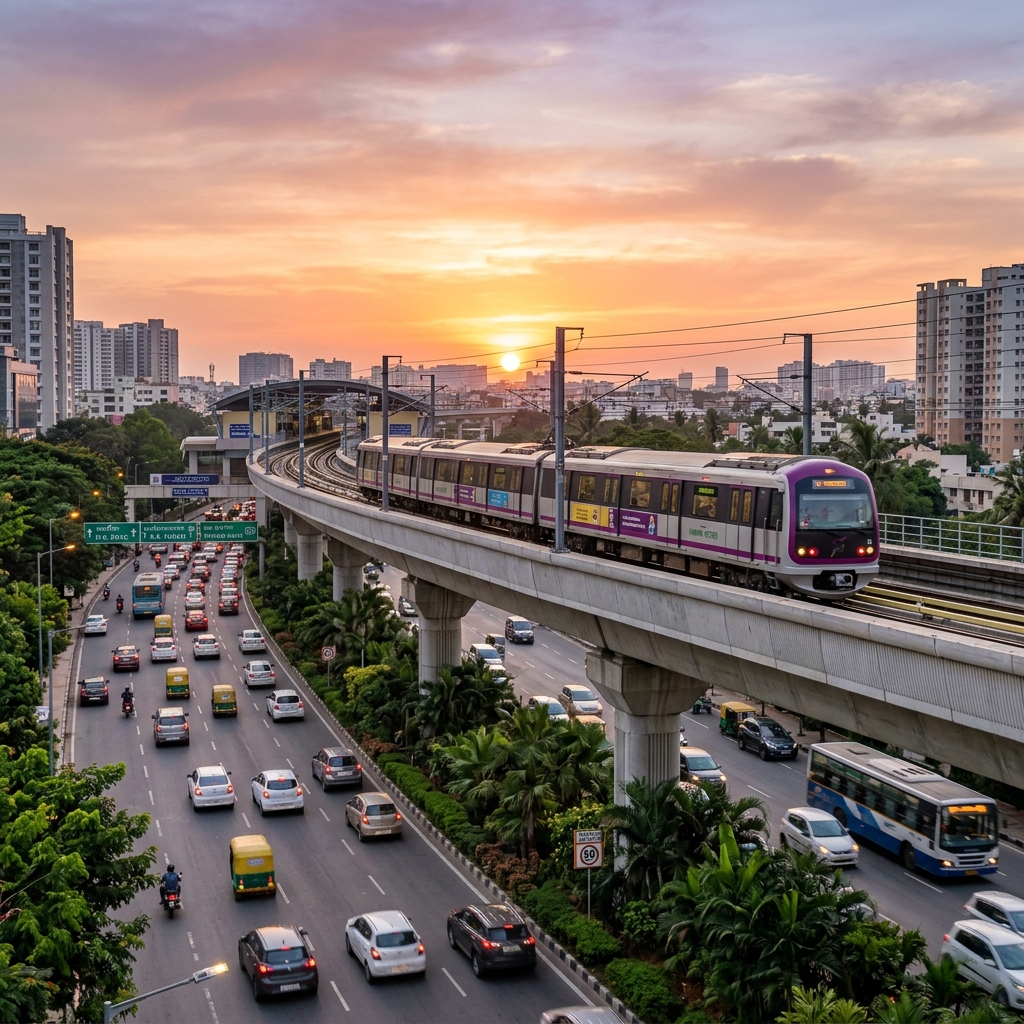
This stretch already benefits from the operational Namma Metro Green Line running to Silk Institute and Konanakunte Cross. The Orange Line's JP Nagar starting point adds a second, complementary connectivity layer to an already well-established residential corridor, which is a genuinely different risk profile than betting on a first-ever metro line in an unproven area.
Hosahalli / Kadabagere (Grey Line)
This corridor is earlier in its development cycle, with less existing social infrastructure than JP Nagar. That typically means higher percentage appreciation potential once connectivity is confirmed, but also a longer runway before the corridor has schools, hospitals and retail catching up to residential demand.
5. A Realistic Investment Takeaway
Metro Phase 3 is a genuine, funded, under-construction project, not a proposal on paper. But a 2031 completion target means this is a five-year-plus horizon investment, not a quick flip. The corridors that make sense today are the ones with independent fundamentals, existing connectivity, established social infrastructure, credible developers, where the upcoming metro line is a bonus on top of a sound purchase, not the entire thesis.