Most infrastructure stories in Bangalore real estate are about what's coming — a metro line planned for 2028, a ring road still in tendering. The Kanakapura Road corridor is unusual in that its two biggest connectivity assets, the NICE Peripheral Ring Road and the Namma Metro Green Line, are already operational today. That distinction matters more than it might first appear.
1. NICE Peripheral Ring Road: A Working Bypass, Not a Promise
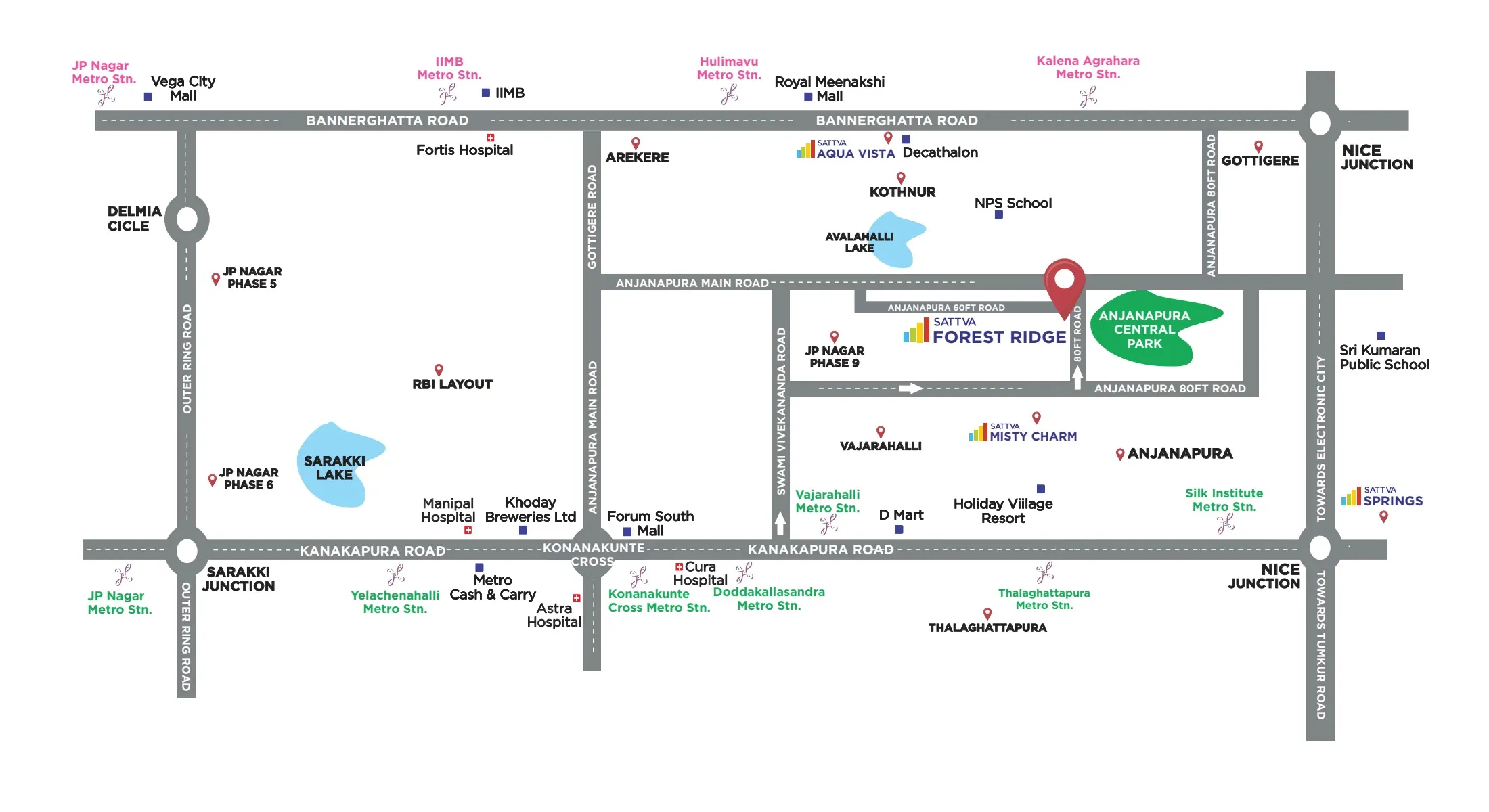
The corridor sits roughly 1.6 km from the NICE Road, which provides a direct route to Electronic City, Mysore Road and Bannerghatta Road — without funneling traffic through central Bangalore. For South Bangalore specifically, this is a rarer advantage than it sounds: most inner South Bangalore micro-markets (Koramangala, HSR, JP Nagar's earlier phases) still rely on congested arterial roads for cross-city or IT-corridor commutes.
What This Means for an Electronic City Commute
Via NICE Road, the corridor offers a realistic ~25-minute commute to Electronic City — one of Bangalore's largest IT employment bases. That's a genuinely usable daily commute, not an aspirational best-case scenario contingent on future road-widening.
2. Namma Metro Green Line: Already Running
The Green Line is already operational to Silk Institute and Konanakunte Cross, roughly 4 km from the corridor. Compare this to corridors where the entire investment thesis rests on a metro alignment that hasn't even had station locations confirmed — Kanakapura Road's rail connectivity is a fact on the ground today, not a multi-year bet.
Planned Improvements Ahead
BMRCL has planned feeder-bus and frequency improvements for the Silk Institute/Konanakunte Cross stretch, intended to tighten last-mile connectivity into the Anjanapura/JP Nagar 9th Phase pocket specifically. This is an incremental upgrade to existing infrastructure, not a first-build — a meaningfully lower-risk profile than corridors waiting on greenfield metro construction.
3. Road Infrastructure: Kanakapura Main Road
Kanakapura Main Road, roughly 3 km from the corridor, is the primary arterial connection into JP Nagar and central South Bangalore. Ongoing widening and junction-improvement works are targeted at easing peak-hour congestion as the corridor's residential base grows — a maintenance-and-capacity story rather than a first-infrastructure one.
4. The Social Infrastructure Layer
Connectivity alone doesn't make a corridor livable — the surrounding social infrastructure has to hold up too. On that front, Kanakapura Road already has:
- Bannerghatta Main Road (~4.9 km) — access to Fortis Hospital, Forum South Mall and the broader Bannerghatta retail and healthcare belt
- Established schools — Delhi Public School (JP Nagar) and National Public School, both already operating in the corridor
- Healthcare — Fortis Hospital Bannerghatta, Apollo Clinic and Motherhood Hospital, all within a short drive
Why "Already Operational" Changes the Investment Calculus
In Bangalore real estate, the biggest single-day price movements typically happen around infrastructure milestones — a metro station opening, a ring road going live. Corridors still waiting on those milestones carry that upside, but also carry the risk of delay. Kanakapura Road has already cleared that hurdle on its two most important connectivity assets, which is precisely why its price trajectory has been steadier — and, we'd argue, more dependable — than corridors still betting on infrastructure that hasn't broken ground.