Chennai's OMR IT corridor is showing a two-speed office market this year, and the details matter for anyone weighing a residential purchase along the stretch. JLL's Q2 2026 Chennai office report put the quarter's gross leasing at 2.3 million sq ft, down 14.6% year-on-year, yet H1 2026 leasing overall held at roughly 4 million sq ft, broadly stable against H1 2025, while net absorption, the more meaningful demand indicator, actually grew 13% quarter-on-quarter. Inside those headline numbers, one sub-market stood out: Peripheral Business District (PBD) OMR, the stretch running roughly from Thoraipakkam and Sholinganallur through Navalur and Egattur, recorded the highest rent growth of any Chennai office corridor in Q2 2026, at 10.8% year-on-year, with the Secondary Business District (SBD) OMR stretch close behind at 5.8%. For residential buyers along this same belt, rising office rents in a corridor is one of the more reliable, if slower-moving, signals of future housing and rental demand.
1. Why Rent Growth on PBD OMR Is the Number to Watch
Office rent growth and residential demand don't move in lockstep, but they are connected through a fairly direct mechanism: when office rents in a corridor rise meaningfully faster than the city average, it typically means occupiers are competing harder for space there, which usually follows from genuine employer demand rather than speculative leasing. PBD OMR's 10.8% year-on-year rent growth in Q2 2026, well ahead of SBD OMR's 5.8%, suggests employers are increasingly prioritising the Thoraipakkam-Sholinganallur-Navalur-Egattur stretch specifically, rather than OMR as an undifferentiated whole. That matters for housing demand because employees working in this specific sub-corridor overwhelmingly prefer to live within a short commute of it, given Chennai's traffic patterns, which makes residential projects positioned along this exact stretch the most direct beneficiaries of the office trend, more so than developments elsewhere on the broader OMR corridor.
2. A Market Adding Supply Even as Headline Leasing Cools
The apparent contradiction in the data, a 14.6% year-on-year drop in quarterly leasing alongside rising rents in the strongest sub-market, is less unusual than it looks. JLL's report also flagged that Chennai expects roughly 10 million sq ft of new Grade A office supply over 2026-2027, with PBD OMR and the SBD together accounting for about two-thirds of that pipeline. A market where developers are actively building new supply into the strongest-performing corridor, even as overall quarterly leasing volumes fluctuate, is generally read as a vote of confidence in that corridor's medium-term occupier demand rather than a sign of oversupply risk; landlords and developers tend not to commit new Grade A space to sub-markets they expect to weaken. For home buyers, that forward-looking supply pipeline is arguably a stronger medium-term signal than any single quarter's leasing number.
- PBD OMR led all Chennai office corridors on rent growth in Q2 2026, at 10.8% year-on-year, suggesting concentrated employer demand along the Thoraipakkam-Sholinganallur-Navalur-Egattur stretch specifically.
- New Grade A supply is concentrating in the same corridor. With PBD OMR and SBD together expected to account for roughly two-thirds of Chennai's incoming 10 million sq ft of office space through 2026-2027, developers are backing this belt's continued occupier demand.
- A planned metro spine to Sholinganallur and SIPCOT is under construction and, once operational, should further ease OMR's notoriously congested peak-hour commute, reinforcing the corridor's residential appeal over time.
3. What It Means for Residential Buyers Along This Stretch
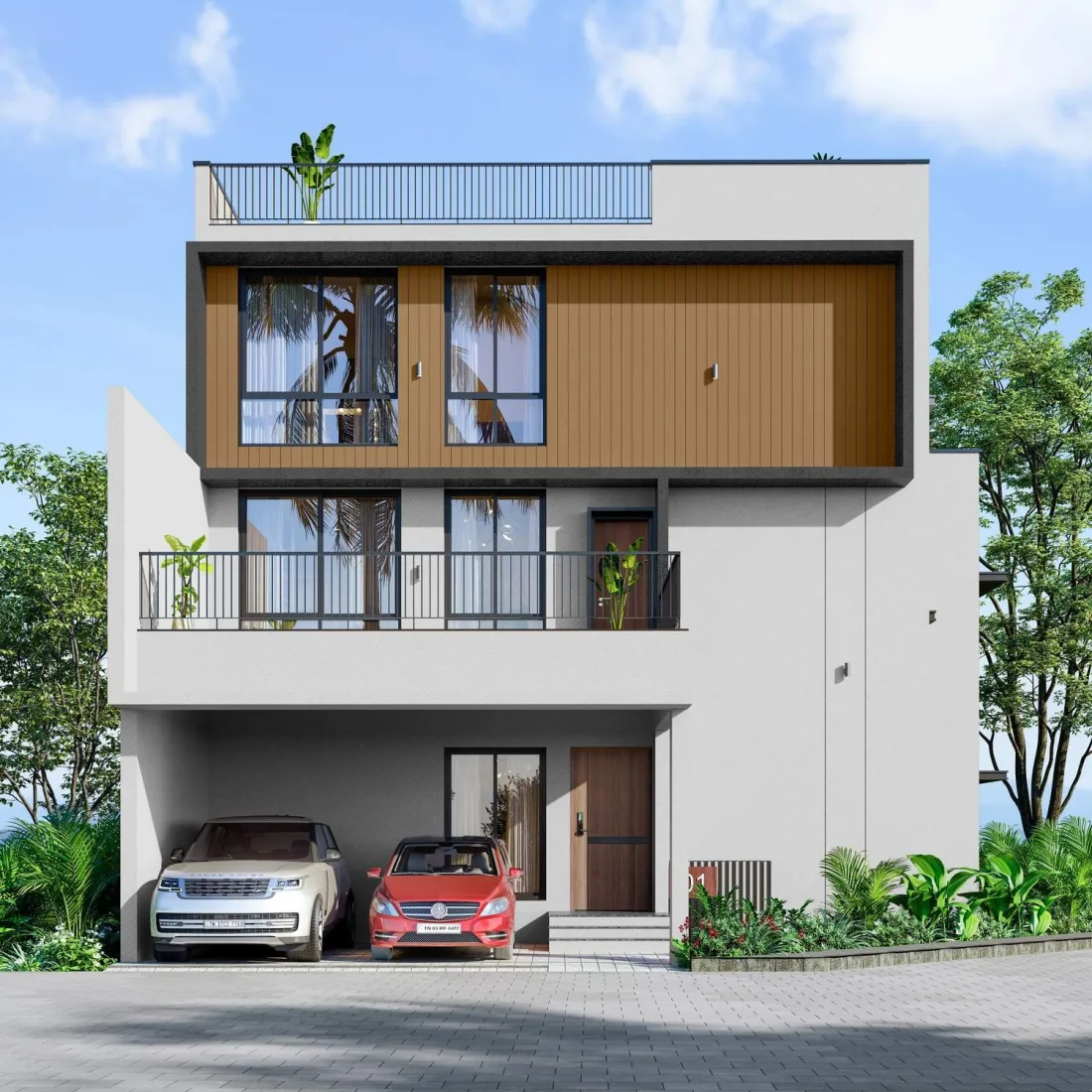
For anyone evaluating a home along the Navalur, Egattur, Thoraipakkam or Sholinganallur stretch of OMR, this office-market data is a useful proxy for the depth of the tenant and buyer pool you'd eventually be renting to or reselling into. A corridor with growing office rents and incoming Grade A supply tends to sustain a steady pipeline of IT and ITES professionals needing housing within a reasonable commute, which supports both rental yield and resale liquidity over the medium term, assuming a project's own fundamentals, builder, price and configuration, are sound to begin with. Projects positioned within this specific sub-corridor, such as Radiance Edgewood in Navalur, offering premium 3 and 4 BHK row villas, or Sobha Wisteria in Egattur, with its range of 1 to 4 BHK apartments, sit squarely in the belt this data describes, though buyers should evaluate each on its own price, RERA status and configuration rather than treating corridor-level data as a substitute for project-specific diligence.
4. A Caveat Worth Flagging
It's worth being precise about what this data does and doesn't tell you. A 14.6% year-on-year dip in overall quarterly office leasing is a real softening at the city level, even if it coexists with strength in one specific sub-market, and office demand overall can be more cyclical than residential demand, tied to hiring cycles at large IT and GCC employers that can slow with little warning. Treat rising PBD OMR rents as a genuine, dated positive signal for this specific stretch of the corridor, not as a guarantee that every OMR-adjacent residential project benefits equally, since location within the corridor, not just proximity to OMR as a whole, is what the underlying office data is actually describing.
The Bottom Line
Chennai's overall office leasing cooled in Q2 2026, but the Thoraipakkam-Sholinganallur-Navalur-Egattur stretch of OMR bucked that trend with the city's strongest rent growth and is attracting the bulk of incoming Grade A supply through 2026-2027. For residential buyers, that is a reasonably reliable signal of sustained housing demand specifically along this sub-corridor, worth weighing alongside a project's own price and fundamentals rather than OMR's broader, more generic reputation as an IT belt. Talk to our team for a closer comparison of projects along this specific stretch of OMR.