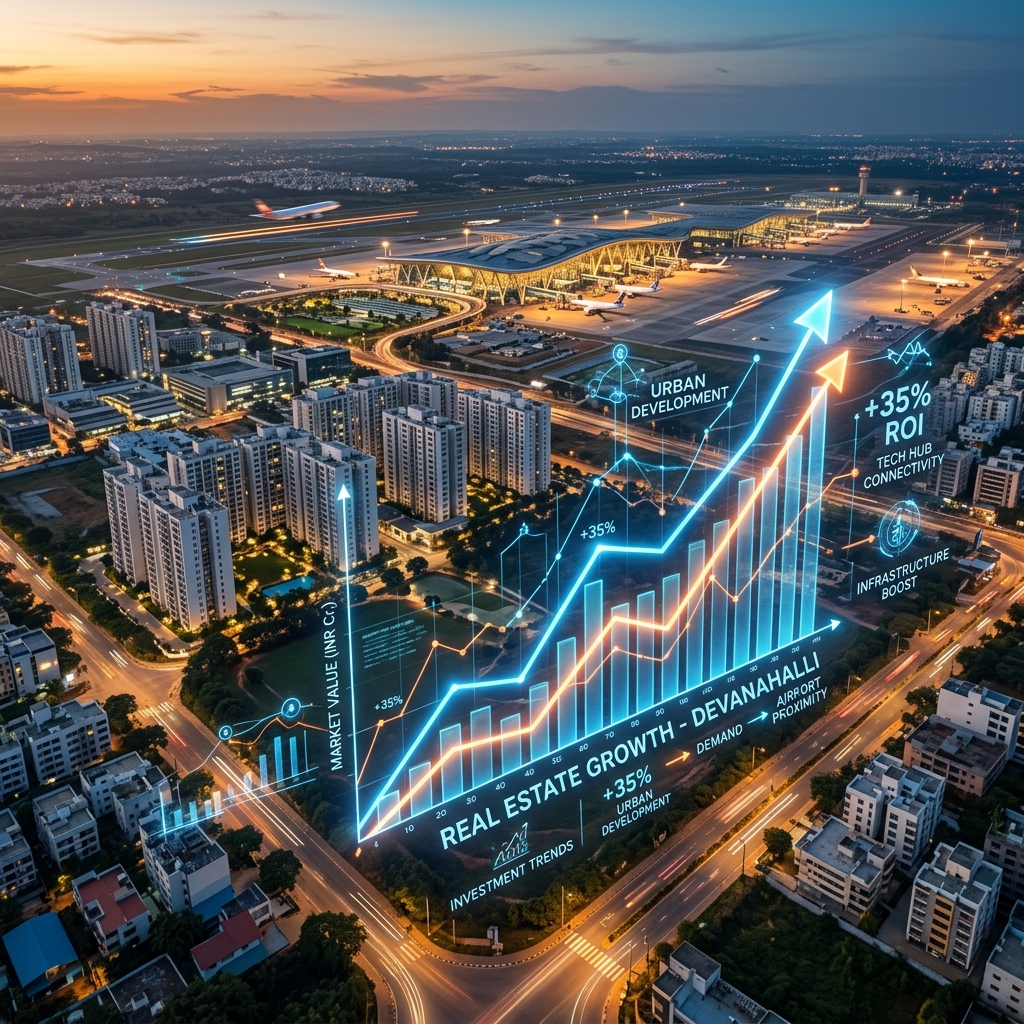
If you are exploring the broader Devanahalli real estate market, you will know that this corridor has consistently outperformed every other Bangalore micro-market for capital appreciation over the last five years. The question in 2026 is no longer whether to invest in Devanahalli — it's which product type and at what stage.
1. Why Devanahalli is Different From Every Other Corridor
Most of Bangalore's growth corridors are driven by IT employment — Whitefield has ITPL, Sarjapur has Wipro and Infosys, Electronic City has its SEZ. Devanahalli is unique because its primary demand driver is an airport — and airports generate a fundamentally different kind of real estate demand.
- NRI and frequent-flyer buyers who prioritise airport proximity above all else
- Aerospace and logistics sector employees who work on or near the airport campus
- Plotted / villa development at scale — something most IT corridors cannot accommodate given land constraints
- Long-term land banking at valuations still significantly below comparable Hyderabad or Pune airport corridors
2. The Infrastructure Roadmap Driving 2026 Prices
Three concurrent infrastructure projects are compounding Devanahalli's appreciation cycle simultaneously:
Namma Metro Yellow Line (Phase 3)
The proposed Metro Yellow Line will eventually connect RV Road to Bommasandra. While the Devanahalli extension is not yet in Phase 2B alignment, the broader metro network expansion is accelerating peripheral land appreciation across the entire northern arc. Every confirmed metro expansion in Bangalore's history has triggered a 15–25% price correction in surrounding areas within 24 months of the announcement.
Satellite Town Ring Road (STRR)
The STRR is perhaps the single most significant piece of infrastructure for Devanahalli after the airport itself. It will create a 280km orbital ring around Bangalore at 25–35km from the city centre — directly passing through the Devanahalli-IVC Road corridor. Once operational, it will reduce cross-corridor commute times significantly, making the area accessible from Sarjapur, Whitefield, and Electronic City without entering central Bangalore.
KIAL Terminal 2 Capacity Expansion
Kempegowda International Airport's Terminal 2 is designed to handle 45 million passengers annually — more than tripling the existing capacity. This expansion will generate tens of thousands of direct and indirect jobs in the airport's immediate catchment, creating sustained rental and residential demand in Devanahalli through at least 2030.
3. Property Price Trends: 2022–2026
| Year | Avg. Price (Villa Plots, psf) | Avg. Price (Apartments, psf) | YoY Change |
|---|---|---|---|
| 2022 | ₹1,800 – ₹2,400 | ₹4,200 – ₹5,500 | Base |
| 2023 | ₹2,200 – ₹3,000 | ₹5,000 – ₹6,500 | +18% |
| 2024 | ₹2,800 – ₹3,800 | ₹6,000 – ₹7,800 | +22% |
| 2025 | ₹3,400 – ₹4,800 | ₹7,200 – ₹9,000 | +24% |
| 2026 (current) | ₹4,200 – ₹6,000 | ₹8,500 – ₹10,500 | +20–26% |
4. Who Is Buying in Devanahalli Right Now?
The buyer profile in Devanahalli has evolved significantly since 2020. In 2026, we are seeing three distinct buyer segments:
- NRI investors (35–40% of buyers): Drawn by airport access and below-Mumbai/Hyderabad pricing for equivalent plotted land products
- Senior IT professionals (30%): Buying as second homes or retirement-oriented investments, attracted by the green, low-density character of the corridor
- Pure land investors (25–30%): Buying approved plotted developments as a hedge against urban land scarcity, with a 5–7 year horizon
The Outlook
Devanahalli is a structural play, not a momentum trade. If you are looking for a 2-year flip, there are more liquid micro-markets. But if your horizon is 5+ years and you are focused on capital appreciation over rental income, the Devanahalli-IVC Road corridor — particularly in the plotted development segment — remains one of the highest-conviction bets in all of South Indian real estate.
.webp)