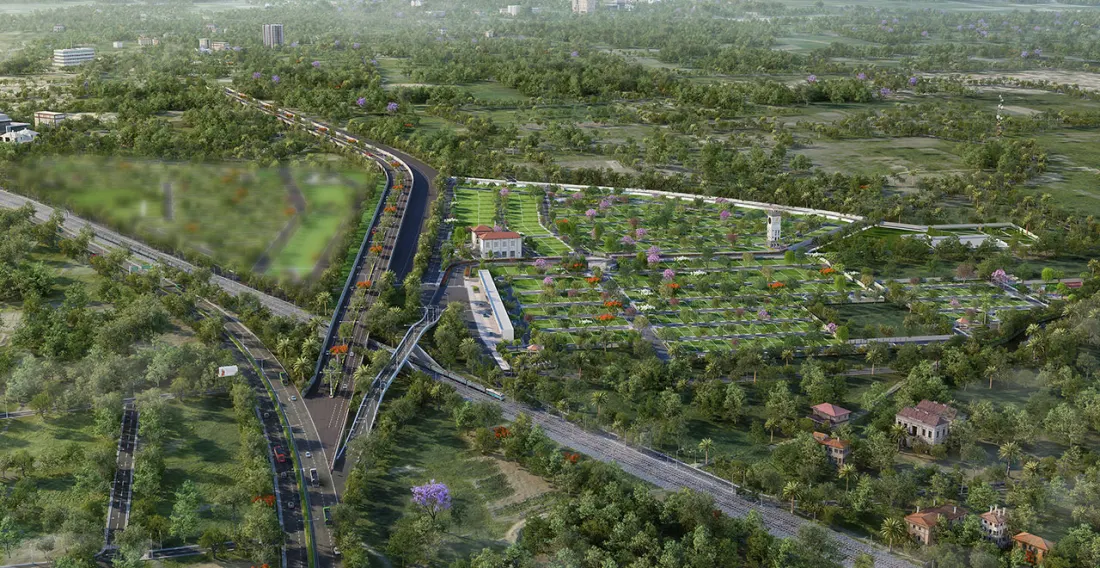
Doddaballapur has historically been known as a silk-weaving town on the northern edge of Bangalore, well outside the city's usual IT-corridor investment conversation. That's changing. A meaningful industrial pipeline, NH-44 connectivity, and its position alongside the Devanahalli-Airport growth belt have put Doddaballapur on the radar for buyers looking at land and plotted developments before prices catch up with the rest of North Bangalore. Here's what's actually driving that interest.
1. A Genuine Industrial Anchor, Not Just a Masterplan Promise
The single biggest recent development for Doddaballapur's real estate story is industrial, not residential. Reports indicate Foxconn has secured roughly 300 acres in the ITIR (Information Technology Investment Region) industrial belt spanning Doddaballapur and neighbouring Devanahalli taluk, for a mobile-device assembly plant reported to involve an investment in the tens of thousands of crores. Alongside Doddaballapur's existing, long-established industrial area and the KIADB Industrial Park, this gives the corridor something many "upcoming" real estate stories lack: a large, already-committed employer base rather than a purely speculative growth thesis.
Quick Distance Snapshot
NH-44 (Bangalore-Hyderabad Highway) ~8 km · Doddaballapur Industrial Area ~5 km · Kempegowda International Airport ~30 km · Manyata Tech Park ~25 km · Bangalore city center ~35 km.
2. Positioned Alongside the Devanahalli-Airport Growth Belt
Doddaballapur sits adjacent to Devanahalli, home to Kempegowda International Airport and the large upcoming BIAL IT Investment Region. It doesn't have Devanahalli's airport-proximity premium built into pricing yet, but it benefits from proximity to the same broader growth belt while starting from a lower price base, a common pattern in Bangalore where a corridor next to an established growth story gets discovered a cycle later, at a discount.
3. NH-44 Gives It Real Highway Connectivity
Doddaballapur sits close to NH-44, the Bangalore-Hyderabad national highway, giving the corridor genuine road connectivity toward both central Bangalore and the wider North Karnataka trade route, not just a local access road. For plotted developments specifically, highway proximity matters more than it does for apartment buyers focused purely on daily commute, since land investors and self-build buyers weigh long-term accessibility for both resale and construction logistics.
4. Sector Diversification Beyond the Traditional Silk Economy
Coverage of the region notes that Doddaballapur's economic base is diversifying beyond its traditional silk industry into IT, electronics and automotive-adjacent manufacturing. That diversification matters for a real estate thesis because it broadens the pool of potential residents and tenants beyond a single industry's hiring cycle, reducing the corridor's dependence on any one sector's fortunes.
5. Land Values Are Still Early-Stage Relative to Established North Bangalore
Property portals and local industry coverage have reported meaningful land-price appreciation in the Doddaballapur corridor over recent years, though estimates vary noticeably by source and by exact micro-location, so treat any single headline percentage with caution. The more durable point is directional: pricing here still sits below established North Bangalore corridors like Yelahanka and Hennur, which is the core of the near-term case for early plotted-development buyers, entry pricing ahead of a corridor's infrastructure and industrial story fully maturing.
6. How Doddaballapur Compares to Its North Bangalore Neighbours
It's worth placing Doddaballapur against the corridors buyers usually compare it to, since each has a genuinely different investment character rather than being interchangeable "North Bangalore" options:
| Corridor | Primary Demand Driver | Relative Pricing | Corridor Stage |
|---|---|---|---|
| Devanahalli | Airport (KIAL), aerospace park | Higher, airport-premium priced in | Established growth corridor |
| Yelahanka | IT/ITES spillover, defence establishments, metro connectivity | Higher, mature social infrastructure | Mature, largely built out |
| Hennur-Thanisandra | Manyata Tech Park IT employment | High, dense apartment stock | Mature, limited fresh land |
| Doddaballapur | Industrial manufacturing (ITIR, Foxconn, KIADB) | Lower entry point | Earlier-stage, land-led |
The practical takeaway: Devanahalli, Yelahanka and Hennur-Thanisandra are all corridors where a large share of the appreciation from their respective demand drivers has already happened and is reflected in current pricing. Doddaballapur's industrial story, by contrast, is still in its earlier innings, which is precisely why entry pricing here remains lower. That's not automatically a reason to buy, an earlier-stage corridor also carries more execution and timeline uncertainty, but it is the honest reason the price gap exists.
7. Social Infrastructure: What's Actually There Today
A common, fair objection to earlier-stage corridors is that industrial jobs alone don't make a livable residential neighbourhood; schools, healthcare and daily-needs retail have to follow. On the Doddaballapur side specifically, buyers evaluating this corridor today have access to established options including Cambridge School, St. John's School and Vishwa Bharati Academy for schooling, and Doddaballapur General Hospital and Navodaya Hospital for primary and secondary healthcare, with Columbia Asia Hospital (a multi-specialty chain) reachable within about 25 km for more specialised care. This is meaningfully more built-out social infrastructure than a purely greenfield industrial corridor would have, though it is still thinner than what a fully mature corridor like Yelahanka offers, worth weighing against your own timeline for actually moving in versus purely holding as an investment.
8. Financing and Holding-Cost Considerations for Land Purchases
Buyers new to plotted-land investing, as opposed to apartment buying, should go in with a clear picture of how the financing and tax treatment actually differs:
- Loan-to-value is lower. Banks typically finance 60-70% of a plot's value (a "loan against property" style product), versus 80-90% commonly available for a ready or under-construction apartment, so plan for a larger upfront cash commitment as a share of the purchase price.
- Tax treatment differs from a home loan. Interest paid on a pure land loan generally isn't eligible for the same Section 24 interest deduction available on a home loan until construction is completed and a completion certificate obtained; at that point, the loan is typically treated differently for tax purposes. Buyers planning to build should factor this into their own return-on-investment math rather than assuming apartment-style tax benefits apply from day one.
- Holding costs are lower but not zero. Vacant land avoids the maintenance charges and depreciation an apartment carries, but still incurs property tax, layout maintenance charges where applicable, and the opportunity cost of capital tied up in an asset that isn't generating rental income until you build.
None of this makes land a worse investment than an apartment, it's simply a different financial profile, and it's worth modelling explicitly rather than assuming the same numbers that work for an apartment purchase carry over directly to a plot.
9. Risks Worth Weighing Before You Commit
An honest investment case has to include the counterpoints, not just the tailwinds. A few worth naming explicitly:
- Industrial timelines can slip. Large manufacturing investments of the scale reported for this corridor typically unfold over several years from announcement to full operational hiring, not overnight. Treat the employment upside as a multi-year thesis, not something that shows up in rental demand within the next 12 months.
- Earlier-stage corridors carry more execution risk on individual projects. A corridor-level growth story doesn't guarantee any single developer's specific layout delivers on time, with clean title and full RERA compliance. The corridor thesis and the project-level due diligence are two separate checks, and both matter.
- Liquidity is thinner than in a mature corridor. If you need to exit within a short window, an earlier-stage market like Doddaballapur will generally have fewer active buyers than an established corridor like Yelahanka or Hennur-Thanisandra, which can mean a longer resale timeline or a price concession if you need to sell quickly.
- Appreciation statistics from property portals vary widely by source. As noted above, headline percentage figures for this corridor differ meaningfully depending on which report you read. Use them directionally, not as a precise number to underwrite a purchase against.
None of these risks are unique to Doddaballapur, they apply to any earlier-stage, industrially-anchored corridor in India, but naming them explicitly is part of giving buyers an honest picture rather than a one-sided pitch.
What This Means for Buyers
Doddaballapur suits two buyer profiles reasonably well: investors comfortable with an earlier-stage industrial corridor in exchange for entry pricing below established North Bangalore benchmarks, and end-users specifically interested in a plotted, self-build option near a genuine (not merely proposed) industrial employment base. It suits less well buyers who need move-in-ready social infrastructure on day one, or who want an apartment-style financing and tax profile without adjusting for the different loan-to-value and holding-cost math that land carries.
As with any earlier-stage corridor, verify a specific project's RERA registration, land conversion status and layout approval before booking, a large developer name reduces but doesn't eliminate execution risk on a new launch, and don't rely on a single headline appreciation statistic without checking it against the specific micro-location you're buying into. If you're evaluating a specific plotted development here, our team can walk you through the current verified numbers, financing options and what to check before you commit. Get in touch for a no-pressure consultation →