Old Madras Road and Whitefield sit right next to each other on the map, share the same broad East Bangalore employment base, and are frequently cross-shopped by the same buyer. But they are not the same market: Whitefield is a mature, largely built-out IT corridor with two decades of infrastructure behind it, while Old Madras Road (running through KR Puram, Krishnarajapuram and out towards Budigere Cross) is where a newer wave of supply, including Sattva Aangane and Sattva Songbird, is currently being built. This guide compares the two corridors directly so you can decide which one actually fits your commute, budget and timeline.
1. What Each Corridor Actually Is
Whitefield refers to the established IT and residential hub built up around International Tech Park (ITPL), with a dense concentration of tech parks (Bagmane Tech Park, RMZ Infinity, Prestige Tech Park among others), international schools, hospitals and mature retail (Phoenix Marketcity, Forum Shantiniketan, VR Bengaluru). Much of its residential supply was built out over the last 15 to 20 years, so the housing stock ranges from older gated communities to newer premium towers on whatever infill land remains.
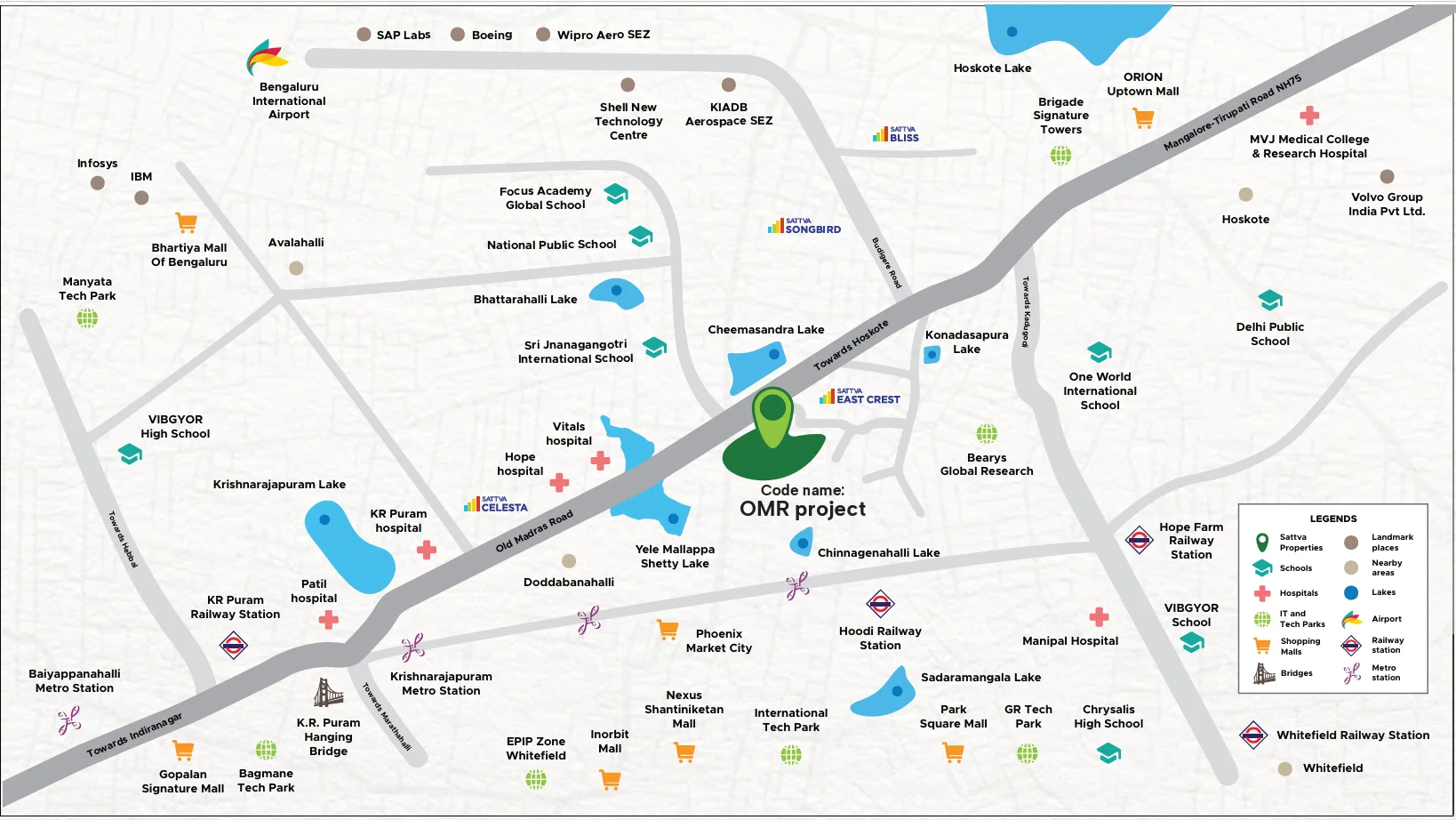
Old Madras Road (NH-75) runs adjacent to and partly overlaps with Whitefield's periphery, through KR Puram and Krishnarajapuram, and continues out through Budigere Cross towards Hoskote. This corridor has historically been a connectivity artery rather than a residential destination in its own right, but that's changing: Sattva Group alone has multiple active projects here, including Sattva Aangane (KR Puram end, pre-launch) and Sattva Songbird (Budigere Cross end, under construction), alongside other developments visible on local project location maps, like Sattva Celesta and Sattva East Crest.
2. Connectivity: Established Density vs. a Growth Artery
Whitefield's core strength is that everything (tech parks, schools, hospitals, malls, the Whitefield and Kadugodi Metro stations on the Purple Line) is already built and operating within the neighbourhood itself. You're not betting on future infrastructure; you're buying into infrastructure that already exists.
Old Madras Road's strength is different: it is the direct road connection between KR Puram, Krishnarajapuram (with its own railway station and metro station) and the Whitefield core, plus onward access via NH-75 towards Hoskote and the wider airport corridor. Projects here effectively borrow Whitefield's job base and social infrastructure via a short drive along NH-75, rather than having that infrastructure on their own doorstep yet. Both Sattva Aangane and Sattva Songbird's own location data lean on this framing directly, positioning themselves relative to ITPL, Bagmane Tech Park and Phoenix Marketcity rather than claiming a fully independent social infrastructure of their own.
3. Pricing: A Meaningful Gap, With the Trade-Off Attached
Whitefield's established status means it generally commands a mature-market premium: land is scarcer, most of the easy infill sites are already built out, and pricing reflects two decades of demand from IT professionals working in the immediate vicinity. Precise current per-sq.ft figures vary widely by micro-location and building age within Whitefield itself, so we'd encourage you to compare specific live listings there rather than relying on a single corridor-wide number.
On Old Madras Road, we can point to concrete, currently advertised figures from the two Sattva projects on this stretch: Sattva Songbird's 2 BHK starts at roughly ₹1.56 Cr (around ₹12,200 to ₹12,300 per sq.ft) and its 3 BHK at roughly ₹1.88 Cr, while Sattva Aangane's pre-launch EOI pricing for larger 3 and 4 BHK homes starts at ₹2.81 Cr and ₹4.15 Cr respectively (working out to a broadly similar ₹12,200 to ₹16,000 per sq.ft range once size is accounted for). As a newer, still-developing corridor, Old Madras Road's per-sq.ft entry points for comparable configurations tend to sit below what an equivalent unit costs deeper inside established Whitefield, which is the core trade-off buyers are weighing: a lower entry price today on a corridor that is still building out its own infrastructure, versus a higher price for infrastructure that already exists.
4. Supply & Project Stage
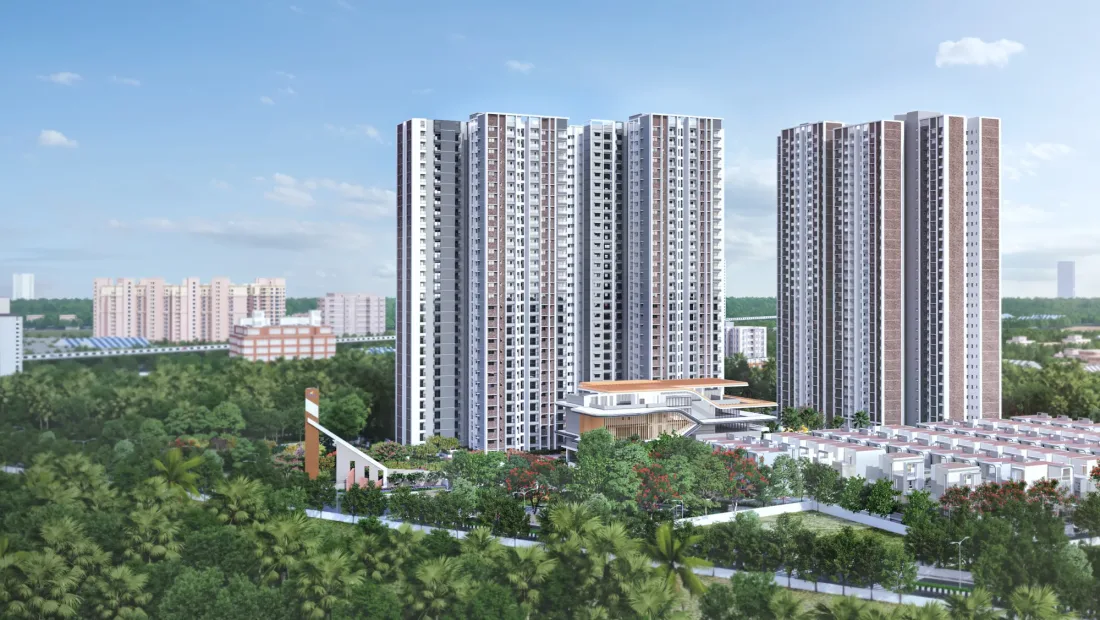
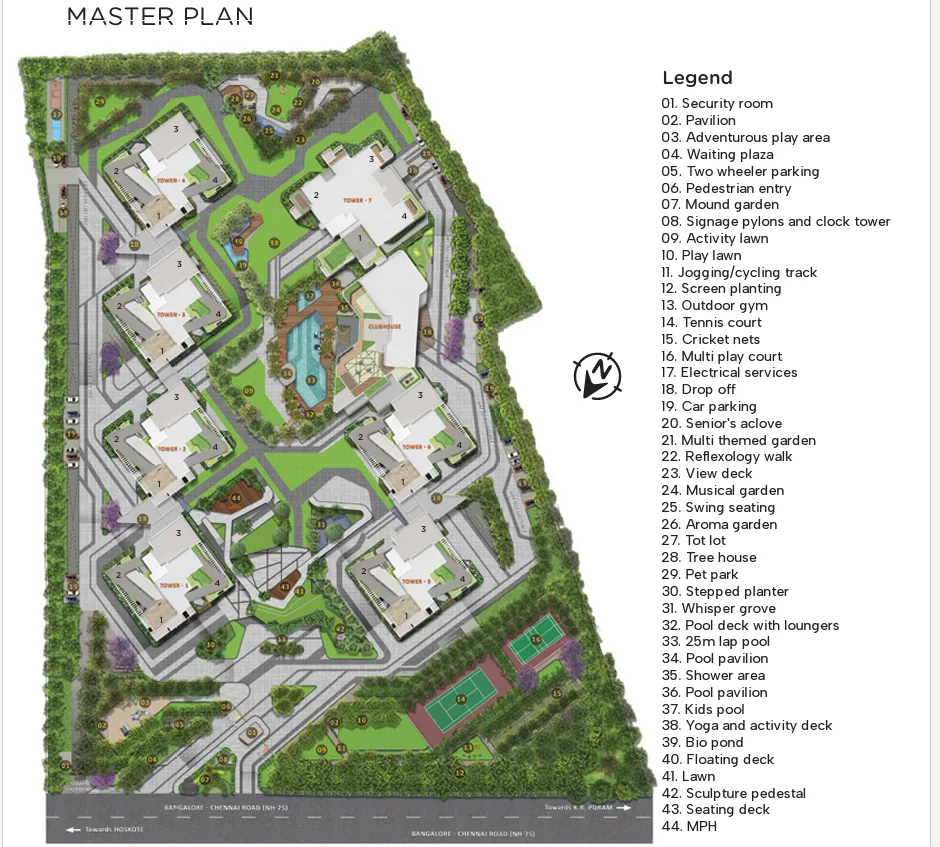
Whitefield's easy-to-develop land is largely spoken for, so new launches there tend to be smaller infill projects or redevelopments rather than large master-planned communities. Old Madras Road, by contrast, still has larger parcels available, which is why you see 10-acre, 8-tower developments like Sattva Aangane and 4-plus-acre developments like Sattva Songbird coming up here rather than in Whitefield proper. If a large, amenity-rich master plan (dedicated clubhouse, multiple sports courts, extensive open space) matters more to you than an established address, the newer corridor currently has more of that kind of supply in the pipeline.
5. Which Corridor Fits Which Buyer?
If you work in central Whitefield and want to minimise your daily commute above everything else, or you specifically want a mature neighbourhood with fully built-out schools, hospitals and retail within a short walk or drive, Whitefield itself remains the more conservative, lower-uncertainty choice, even at a pricing premium.
If you're commuting to Whitefield, ITPL or Bagmane Tech Park but don't need to live inside Whitefield itself, are comfortable with a short additional drive along NH-75, and want either a lower entry price (Sattva Songbird's Studio-to-3-BHK range) or a larger, newer master-planned home (Sattva Aangane's 3 and 4 BHK homes), Old Madras Road is worth serious consideration, provided you go in with clear eyes about which specific project's RERA and construction status you're relying on.
Investors weighing rental yield versus appreciation should also note the asymmetry: Whitefield's rental market is already deep and liquid given its IT-tenant base, while Old Madras Road's rental market is still forming alongside its residential supply, meaning near-term appreciation potential may be higher but current rental liquidity is likely lower than in established Whitefield.
6. Social Infrastructure: What Exists Today vs. What's Coming
Whitefield's schools, hospitals and retail have had two decades to mature: institutions like VIBGYOR High School, Delhi Public School and a wide spread of international curricula schools sit alongside established hospitals and multiple large malls (Phoenix Marketcity, Forum Shantiniketan, VR Bengaluru, Inorbit Mall) that have been trading for years. If you have school-age children or want mature healthcare infrastructure within a short drive, that maturity is difficult to replicate on a newer corridor regardless of price.
Old Madras Road's social infrastructure is a mix of borrowed proximity and its own emerging supply. Projects here sit close enough to Whitefield's own schools, hospitals and malls to use them (VIBGYOR, Delhi Public School and Manipal Hospital all appear on Sattva Aangane's own location map, for instance, alongside Phoenix Marketcity, Inorbit Mall and Nexus Shantiniketan Mall), but they aren't inside the neighbourhood with the density of options Whitefield itself offers. As more residential projects complete along this stretch, expect retail and social infrastructure to follow, but buyers moving in during the next few years should plan around a short drive to Whitefield-side amenities rather than assuming walkable equivalents will already exist on Old Madras Road itself.
7. Road & Transit Upgrades Worth Knowing About
Old Madras Road benefits from more than just NH-75 itself. The Satellite Town Ring Road (STRR) network, cited in project-level location data along this stretch as roughly 15 minutes away, is designed to improve ring connectivity around Bangalore's outer corridors, and the KR Puram and Krishnarajapuram Railway Stations plus the Krishnarajapuram Metro Station give this corridor rail options that some purely road-dependent growth corridors lack. Whitefield's transit backbone is the Purple Line of Namma Metro, with the Whitefield and Kadugodi stations already operational, giving it a metro connection Old Madras Road doesn't yet have at its Budigere Cross end, though the KR Puram end of Old Madras Road sits close enough to Krishnarajapuram's own metro station to partly close that gap.
Neither corridor is transit-starved, but the nature of the transit differs: Whitefield's metro access is more direct and already built into daily commute patterns for residents there, while Old Madras Road's advantage is more about road network flexibility (NH-75, STRR access, and proximity to two railway stations) than a single metro line running through it.
8. A Practical Way to Decide
Rather than treating this as an abstract corridor debate, map it against your own three biggest constraints: your actual daily commute origin and destination, your budget ceiling, and how much uncertainty you're willing to accept in exchange for a lower entry price. If your commute genuinely starts or ends inside Whitefield itself and your budget can absorb the premium, the maturity argument for Whitefield is hard to beat. If your commute tolerance extends to a short additional drive along NH-75 and you'd rather pay less per sq.ft today for a larger, newer home, or a wider range of unit sizes, Old Madras Road's current crop of Sattva launches gives you a concrete, currently-available way to act on that trade-off. The wrong approach, in our experience, is picking a corridor first and then forcing a project to fit it. Start from the commute and budget constraints, and let those point you to the right corridor rather than the other way around.
Our Honest Assessment
Old Madras Road and Whitefield aren't really competing for the same dollar so much as offering two different bets on the same broader employment corridor. Whitefield is the safer, higher-certainty, higher-price option: you know exactly what you're getting because it's already built. Old Madras Road, anchored today by projects like Sattva Aangane and Sattva Songbird, is the lower-entry-price, higher-uncertainty option: you're paying less per sq.ft today in exchange for betting that the corridor's infrastructure and social fabric catch up to Whitefield's over the coming years. Both are reasonable choices depending on your risk tolerance and how much you value living inside fully mature infrastructure versus getting in early on a corridor that's still developing. Whichever direction you lean, verify the specific project's RERA status, construction stage and exact distance to your actual daily destinations before deciding, rather than relying on corridor-level generalisations alone.